How does Google decide which massage clinics show up first?
Google ranks local results on relevance, distance and prominence. Relevance is how well your profile matches the search, and distance is how far you are from the searcher. Reviews are part of prominence, and Google’s local ranking guidance says more reviews and positive ratings can help a business’s local ranking.
Only a business with a Google Business Profile can appear in the map results. American Massage Therapy Association research from 2024 found that only 66% of US massage businesses have one. Demand is there: Google search volume data for 2026 shows about 201,000 US searches a month for “massage therapy” alone. Choose the correct category, keep your hours and booking details current and add reviews steadily. That last task is what our done-for-you review service does for you.
Do Google reviews bring in new massage clients?
Yes. Referral is the most common route to a massage therapist, and many clients also use Google. American Massage Therapy Association research from 2024 found that 81% of US consumers find their massage therapist through a referral. It also found that 48% of massage clients googled massage therapists nearby to find theirs.
The two figures overlap, so some clients used both routes. A person who is given your name can still look you up on Google. There they see your star rating, your review count and your newest reviews. People who search with no referral see the same things. These figures cover the United States, and we found no comparable published figures for Canada.
What star rating does a massage clinic need on Google?
A rating of 4.5 stars or higher is the one to aim for. A 2024 survey of more than 1,400 US salon and spa consumers found that 49% will only consider a business rated 4.5 or higher. It also found that 78% check online reviews before visiting, rising to 93% among those aged 33 to 44.
These figures cover salons and spas broadly, not massage clients alone. Your star rating is an average of all your reviews. On a small profile, each new review shifts the rating a long way. On a large profile, it shifts very little. Asking every client raises your total, so your rating reflects your whole client base.
How many Google reviews does a massage therapist need?
There is no fixed number. Google has not published a review count that guarantees a place in the map results. The count to pass is the one held by the businesses that appear for your searches.
Independent therapists often appear beside franchise locations and spas with large totals. Each location is ranked on its own profile, so a smaller business can still be listed for searches made close to it. A new practice can start by asking every client from its first week. Position can change: Massage Addict went from 6th to 1st on Google in 5 months. More client outcomes are on our results page.
How recent do massage reviews need to be?
Some should always be from the last three months. A 2026 survey of 1,002 US consumers found that 74% look for reviews written in that period. That survey covers all local businesses.
A massage clinic has many clients it can ask. The American Massage Therapy Association’s 2025 consumer survey found that US massage consumers received an average of 2.7 massages in the past 12 months. So a year of appointments is spread across many separate clients. Flamingo Flow sends requests to new clients and to clients from up to the last two years. They go out in small batches, so new reviews keep appearing on your profile.
When should a massage therapist ask for a review?
Send the request by text after the appointment, on the same day. Asking does produce reviews. In a 2026 survey of 1,002 US consumers, 83% of US consumers who were asked to leave a review went on to leave one.
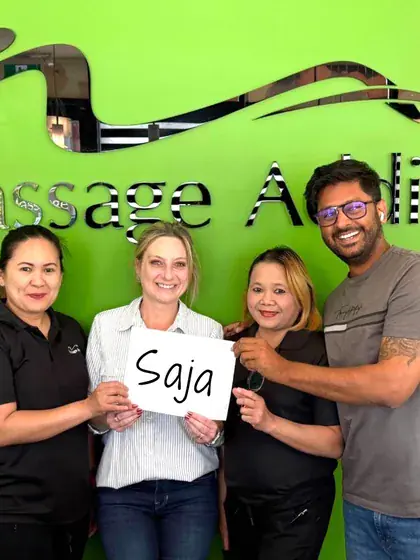
A text includes the link and reaches every client. Each client gets a personal text from Flamingo Flow. It has a photo of you holding a sign with their name on it. Gentle reminders can follow, and you pick how many, or none at all. A clinic that also wants a printed option at reception can use a QR code that opens its Google review page.
Is it okay to ask massage clients for Google reviews?
Yes. Google permits asking, and your regulator may add rules of its own. Google’s Maps User Contributed Content Policy does not permit incentives such as payment, discounts or free goods and services in exchange for a review. It also prohibits discouraging negative reviews and asking only the clients you expect to be positive.
For a massage business, that rules out money off the next appointment or a free product for a review. Asking every client the same way, with nothing offered, is within Google’s policy. That is how Flamingo Flow asks. Where massage therapy is regulated, the regulator or college sets its own rules on testimonials. Read its current guidance and follow it. Our compliance page describes how requests are sent.
Can a massage therapist who works alone get Google reviews?
Yes. A therapist who sees clients in person can have a Google Business Profile. You need a profile before you can collect any Google reviews. Reviews work on it the same way as on any other profile.
Google offers a setting that hides your street address and shows a service area instead. Its guidelines describe that setting as meant for businesses that travel to their customers, so it fits a mobile therapist. If you work from a home studio, read Google’s guidelines before you choose. If you rent a room, the guidelines let you hold a profile separate from the business you work inside. You must be directly contactable there during stated hours.
How do I reply to a bad review of my massage clinic?
Keep the reply short and general, and give a phone number or email for direct contact. Most readers expect a reply. A 2024 survey of more than 1,400 US salon and spa consumers asked about this. More than 8 in 10 believe a business should respond to negative reviews.
Flamingo Flow replies to every review for you, in your own voice. It also helps more of your happy clients leave reviews. The more positive reviews you have, the less a single bad review changes your overall rating. Follow your regulator’s or college’s rules on privacy and public statements.
How do I get a fake review removed?
Report it to Google, which makes the decision. Use your Business Profile and name the part of the content policy it breaks. Google’s Maps User Contributed Content Policy covers reviews that are not based on a real experience. Google’s rules also restrict obscene, harassing and off-topic content.
Google does not remove a review because it is negative, and it gives no guarantee and no timeline. Before you report a review as fake, check the name against your booking records. If nothing matches, a short reply can say you have no record under that name. The more real, recent reviews a practice has, the less any single review changes its average rating.
Should a massage therapist pay for Google ads or focus on reviews?
They do different jobs, and reviews stay on your profile after an ad budget ends. An ad buys a position while it is paid for. Reviews count toward the unpaid map results. Your rating and review count are also shown to anyone who reaches your profile from an ad.
Most massage clients arrive by a route that an ad does not create. American Massage Therapy Association research from 2024 found that 81% of US consumers find their massage therapist through a referral. A referred name can be looked up on Google. The plans on our pricing page all contain every feature. The only difference between them is how many clients you ask each month.
Should I ask for reviews myself or use a service?
A service takes the least of your time. Asking in person costs nothing and depends on remembering after every appointment. Software sends the message, but you still set it up, keep the client list current and write the replies.
A done-for-you service does that work. Flamingo Flow runs by itself after a single setup, and a dedicated account manager is included. It shows where you rank on Google for the searches that matter. Compared with the industry standard, it produces 4x more reviews. The 600+ local businesses using it have had 250K+ review requests sent for them. Physiotherapy clinics and chiropractors are set up through the same process.
Do you support massage clinics with multiple locations?
Yes. Franchise groups and clinics with several locations are supported. Each location is run separately, since each has its own Google Business Profile, reviews and ranking.
Staff members are unlimited and cost nothing extra to add. Reviews from each location’s clients go to that location’s own profile. A dedicated account manager looks after your account. A change in map position takes longer than the first reviews and depends on local competition. Google does not publish a timeline for it. To discuss your setup, contact us.
What is massage therapy reputation management?
Massage therapy reputation management is the care of what appears with your name on Google. That means your star rating, how many reviews you have, how recent they are and how you reply. Google places these beside a practice’s name in local search results and on Google Maps. A referred client also finds them on looking you up.
Flamingo Flow covers three things. It asks real clients for reviews by text, so new ones arrive steadily. It replies to every review in your voice. It tracks where your practice ranks for its main searches. Public relations work, running social media accounts and removing content from search results are not part of it. For more, see our page on reputation management for local practices and businesses.
How long does setup take?
One 15-minute call sets up a massage practice. We need one photo of you holding up a blank board or paper. We open your account and connect it to your client list or booking software. If you keep client details in a spreadsheet, you can upload that list instead.
After that it is all automated, and the first reviews typically arrive within 24 hours. Follow the rules on consent for text messages that apply where you practise. No contract is signed, and your first 7 days are free.

 How Dr. Safana doubled new patients organically
 How The Smiths grew monthly revenue by $25K with a top 3 spot on Google Maps